
My Short Stint in Prison
Discretion advised: descriptions of suicide and use of profanity
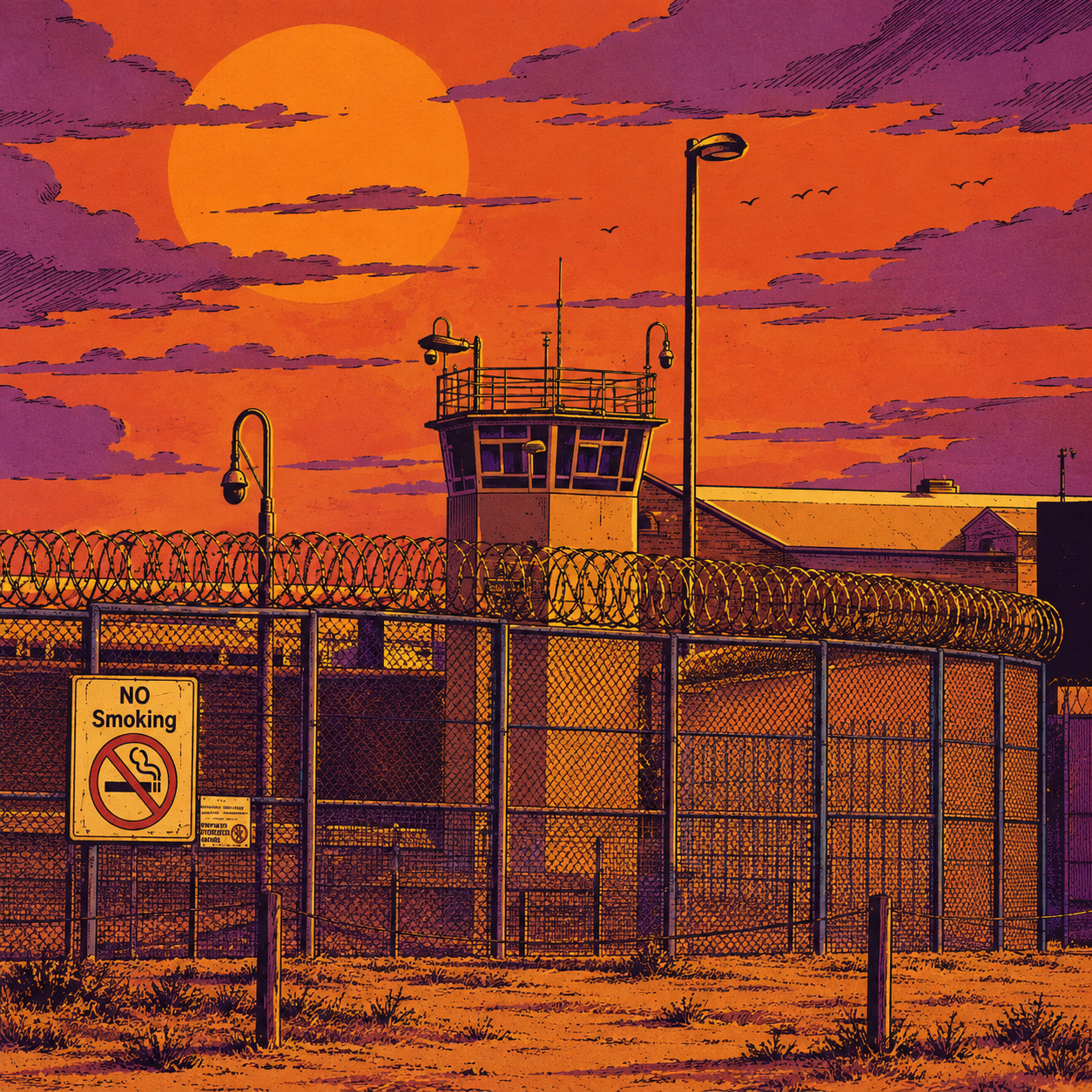
For 12 months, I filled a paternity-leave contract at Yatala Labour Prison, the main correctional facility in South Australia. I was a member of a small clinical team that oversaw the High Dependency Unit (HDU), effectively an inpatient psychiatric ward within the prison. This is a brief description of what it was like.
My main job was completing suicide risk assessments with prisoners, usually after they had disclosed suicidal ideation to one of the correctional officers (COs). When this occurred, the CO would activate a protocol: the inmate had to strip fully naked and change into a canvas smock that was impossible (or, at least, difficult) to tear. They were then transferred to a single-occupant, camera-equipped cell while they waited for me to come and conduct the risk assessment. I would talk to them through a small trapdoor and complete a form to help determine their current risk of suicide.
In almost every instance, I wrote “non-acute”, meaning not currently suicidal but requiring further monitoring and assessment. Usually, the prisoner was having a conflict with another inmate and had made a suicidal statement as a way of getting some separation. On other occasions, they just wanted some time by themselves. Detecting that these “secondary gains” were at play did not require any special investigative techniques. The inmates assured me that they weren’t suicidal and would give the real reason why they had wanted to leave their unit. I would sometimes ask them how long they wanted to be gone for; they typically didn’t know. Next, I would write a report, and then I or another psychologist would return to them each day until they were ready to go back to their unit block.
This process took up considerable resources. I was being paid the equivalent of $100k per year, and this was nearly all I did. In the past, when I have described all this, some people have asked about “calling the bluff”, given that the prisoners were wasting everyone’s time and that their malingering was being rewarded by an overly accommodating system. If we follow the game theory just a few steps, however, it’s clear that this wasn’t a good option.
If a more serious display of suicidal behaviour were required before an emergency protocol was activated, this would certainly be a threshold that many inmates would willingly reach. I know this because new inmates, unfamiliar with the prison system, would sometimes undertake suicidal behaviours in an attempt to get into the HDU. A common way of doing this was by swallowing batteries from the TV remote, which triggered a hospitalisation transfer until they had passed through the inmate’s digestive system.
Even when an inmate had been literally stripped of all means of self-injury and placed in a cell specifically designed for safety, it wasn’t possible to prevent them from hurting themselves. I once watched two correctional officers have to pull an inmate out of his toilet, where he had positioned himself vertically, headfirst, with his legs and feet rigid in the air like a diver. The method here was that, by standing on his head in the toilet, he could topple over under the weight of the rest of his body, causing his neck to snap against the rim of the bowl.
Brief research has told me that this is not a recognised or formally documented suicide mechanism in forensic mental health, given that the curvature of prison toilet bowls, combined with the human body’s involuntary protective reflexes, makes it an improbable way of causing a fatal injury. (If, at some point while reading this, you start to notice a recurring theme of shit, please understand that this is true of most prison stories and not a bias exclusive to the author.)
But even so, the occasion I witnessed still required a hospital transfer and a lockdown of the HDU. In the end, it was safer, easier, and, in the long run, less resource-demanding for us to treat all suicidal gestures as serious. The fact that inmates doing so for secondary gain could quickly admit this without losing their incentive made it easier to triage them from those who were genuinely suicidal.
And amidst the malingering, actual suicidal intent was a common occurrence. From 1996 until 2010, 25 inmates died by suicide in South Australian prisons (Austen et al., 2014), averaging about one every nine months. (From this number, we can assume several times more instances of near-fatal attempts.)
One correctional officer (CO) told me how they had once had to watch an inmate bleed out in front of them. The prisoner had cut open their arteries before reconsidering the decision and activating the emergency alarm in their cell, screaming for help from staff. The CO had to explain that, as per prison protocol, they literally couldn’t open the cell door until backup arrived with individual cell-door access. Both the inmate and the CO were then locked in place for the next few minutes, which became increasingly clear to both of them was too much time.
In another story, there was no reconsideration. The CO ran towards the cell in response to the emergency call and found the inmate sitting on the edge of the mezzanine with a makeshift noose around their neck. Evidently the prisoner had been waiting for them so that before jumping they could make eye contact and say one last “fuck you” to the CO as the impromptu representative of everything.
I have no problem believing that suicide is sometimes an act of vengeance. This idea goes against logic given that by committing suicide we lose everything, including the ability to witness the impact the act has on others. Then again, we all often act for the appreciation of imaginary audiences or navigate socially according to a perception of others that they don’t actually have. Certainly, for the inmates, the prison officers became stand-ins for something else they were angry at.
It was a hard job to do. When a prison is running normally, which is most of the time, not much happens, which can lull one to sleep before the inevitable breakout of violent chaos. Most of the officers I met had been assaulted, all of them had been abused, and everyday someone would try to manipulate them.
If you randomly picked five Australian adults, the resulting group might look like a typical shift of COs. Men and woman, every age, ethnicity, body type, and disposition was represented. If certain factors tended to attract certain people to work in prisons, these factors must have changed several times over the years. If they did have one thing in common, it was perhaps an interest in psychology. Every shift, conversation amongst the COs centred on questions such as: How do you differentiate mental illness from malingering? Were psychopaths born or developed? Was it even possible for most criminals to rehabilitate? They weren’t just discussing these topics because I was there. In one day, I saw three different officers reading Jordan Peterson’s 12 Rules for Life. People might make assumptions about that, but at different times I also saw officers reading Gabor Maté, Viktor Frankl, and Russ Harris.
If there was, however, a school of psychology that represented the prison system and the training of most of the officers, it would undoubtedly be behaviourism. Every discussion of an inmate, even when the exact language wasn’t used, was about punishment and reinforcement. This made sense: the daily goal of a prison officer was ultimately to facilitate all prisoners complying with the rules, and analogies to dog training were difficult to avoid, and occasionally used explicitly.
This occasionally brought the psychology team into friction with the correctional officers over how best to manage behavioural issues among the inmates. The psychologists typically wanted more flexibility so that individual prisoners could be supported according to their circumstances, while the officers typically wanted stricter protocols to avoid any chance of misbehaviour being accidentally reinforced through secondary gains.
I’m not opposed to behaviourism as a school. The principles of operant and classical conditioning are logical, useful, and about as well evidenced as anything in psychological science can be. But humans are far harder to train than rats or pigeons, not that they’re all that easy to train either. Skinner (1948) determined that, before attempting a positive-reinforcement training regime, it was first prudent to starve the rat or pigeon to 75–80% of its body weight. More problematically for behaviourists was the Harlow (1958) experiment, where infant monkeys overwhelmingly preferred the surrogate “mother” made of soft terry cloth over the one made of wire that dispensed all the infant’s food and thus should have been providing a higher rate of positive reinforcement. The explanation offered is that the monkeys’ desire for bodily contact is not conditioned but rather evolutionarily hardwired, just as psychologically healthy humans reach this destination by way of unconditional love from their early attachment figures.
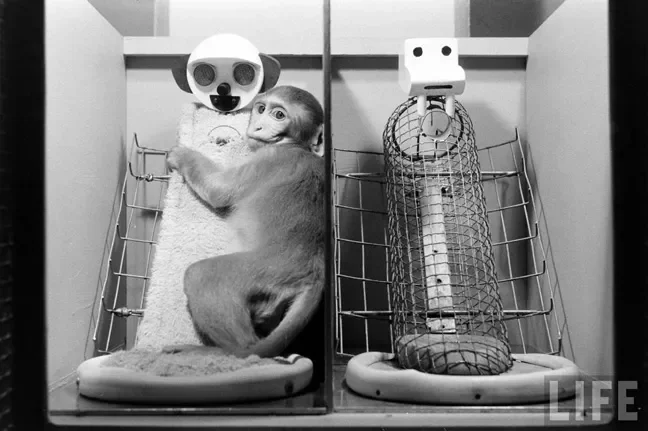
Baby monkeys spent almost all their time on the cloth mother. They only went to the wire mother briefly to feed.
Prisoners don’t have access to mannequins made from terry cloth. However, all prisoners do have surrogate parental figures. The COs bring them their food, tell them the rules, make them tidy their rooms, and go to them in the middle of the night when they get sick. Sometimes they also yell at them, belittle them, and insinuate that the prisoner is something of a disappointment. I’m not suggesting that prisons should try to develop an approach in which officers attempt to fulfil the role of a quasi-parental figure. I’m saying that this role is unavoidable. I doubt it could actually be leveraged either. It wouldn’t require an overhaul of prison protocol, but perhaps just some additional training on attachment theory and, particularly, co-regulation. But even this would be tough for most of the officers to stomach. Such an approach could also have some unintended consequences that might ultimately undermine the mental well-being of the staff. Across the prison, there was a general attitude of dehumanisation towards the inmates. Early on, I found that I had adopted this too, and I can see it evident in what I’ve written so far. Sadly, to work in a prison, this seems to be entirely necessary.
One day, I was sent to a different unit of the prison to do a risk assessment. When I peeked through the trapdoor into the cell, I saw a man standing naked with his back to me. He was using his own excrement to write the word “SHIT” in capital letters across the wall of his cell, like some form of expressive meta-art. His font and spacing were immaculate, although he was running out of material to complete the T.
“Are you okay?” I said.
The man turned and slowly walked towards the cell door, then squatted so he could speak to me through the trap.
“I’m playing with my own shit; do I look okay?”
Aside from the man’s actions, his speech, perception, cognition, judgement, affect, and thought process all seemed to be entirely normal, or clinically unremarkable. It also wasn’t clear what secondary gains he could be seeking, given that he was already in a single cell and hadn’t asked for anything nor spoken to anyone prior to starting his mural.
“Is there anything I can do to help?”
The man got up and walked back towards the wall.
“Probably not,” he said.
—————————————-
Ned Dickeson is a clinical psychologist based in Adelaide, Australia.
This essay is based on real events but some liberties have been taken to ensure that individuals are not identifiable.
I have used AI for artwork and proofreading but not for ideas or prose.
—————————————--
Refrences
Austin, A. E., van den Heuvel, C., & Byard, R. W. (2014). Prison suicides in south Australia: 1996–2010. Journal of forensic sciences, 59(5), 1260-1262.
Harlow, H. F. (1958). The nature of love. American Psychologist, 13(12), 673–685.
Skinner, B. F. (1948). "Superstition" in the pigeon. Journal of Experimental Psychology, 38(2), 168–172.
