
A Model To Understand Relationships
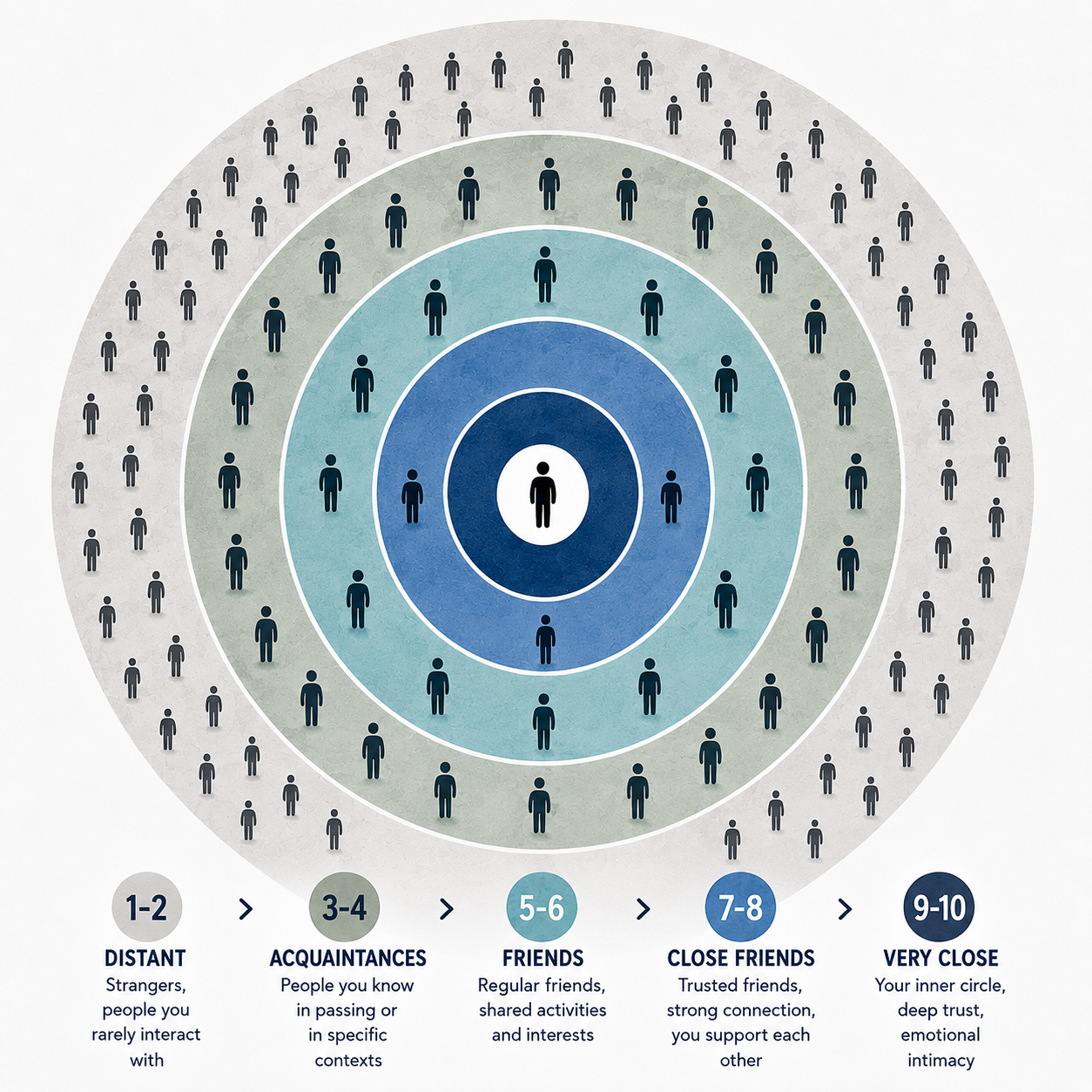
This is a theory (hypothesis) that I formed across several years while working collaboratively with a number of people who had long-term social anxiety and/or were on the autism spectrum. It is a very number-based and hyper-rational approach to friendship, it won’t land for everyone and certainly doesn’t aim to capture the full complexity of intimacy. But most people I’ve shown it to have found it somewhat helpful or interesting.
The artwork is the model; imagine relationships as a scale of 1 to 10, where “10” = a very close friend, like a spouse or occasionally known as a “ride-or-die”, and “1” is someone we barely know.
From here, the following observations can be made:
1. The lower the number, the bigger the circle.
We’re always going to have more 1s than 3s and more 4s than 8s. The specific criteria for each scale is determined by the individual but for many people a 10 tends to be a once-in-a-lifetime.
This filter here is partly down to time constraints; there’s about 730 hours in a month and each relationship needs a certain amount of those invested towards to avoid deteriorating (“drifting apart”).
Beyond this, sometimes lower-level relationship come at the direct cost of higher ones, such as the best friend who can’t hang out as much after they got a boyfriend/girlfriend. Even more brutally, sometimes a group of friends will elevate their mutual level with one other at the direct expense of someone they demote to a lower level. Like when a group of friends gossip together that they no longer like Friend X.
2. We could make a decent assessment of someone’s social world just by knowing what their overall scale looked like.
Some people have vast circles of friends at levels 10 to 6, and then nothing higher. In high school this was the kid who was on good terms with everyone and able to seamlessly travel in and out of all the different cliques, but didn’t feel as though they really belonged anywhere. At the other extreme some people might only have a 10, such as a widow whose life-partner dies and suddenly finds themselves entirely isolated. Ideally we might all have a social world that on the scale would look something like a pyramid.
3. The lower the number, the easier it is to reach a higher number.
For example, at work if we muster up the courage to introduce ourselves to a colleague we previously knew only by sight, then we have, almost by definition, entered a higher level of familiarity with them (say, gone from a 2 to a 3). Barring a meteor strike occurring at the same time, we can achieve this with almost a 100% success rate.
For this reason, if people have a goal of making more friends and becoming more socially engaged, it’s probably better to focus on the lower numbers to start with. Possibly creating large enough base of level 2-3 friendships will naturally trigger a smaller amount of these into closer friendships.
For the specifics on this, Carnegie's (1937) advice is difficult to improve upon: go first, use people's names, show interest, and signal warmth. Basic stuff and easy enough in theory. In actuality those four basics will almost be the first skills to suffer when we encounter social anxiety. As described in the trichotillomania protocol, the worst possible moment to learn those four skills are in a social interaction that you care about.
Fortunately, the customer service interactions that come with weekly purchases (groceries, fuel, coffee) offer ample opportunity to practise these skills in interactions we don't particularly care about (name usage perhaps excepted).
4. The higher the number, the less control we have about going to even higher numbers.
Moving beyond acquaintance is going to start depending on a harder-to-understand set of factors including timing, opportunity, compatibility and what the other person wants. This is probably too complicated to be summarised into a 4-point-guide as might be possible with lower numbers, but typically people who enter higher levels of friendship do so via reciprocal patterns of increasing self-disclosure (details that one wouldn’t typically divulge to an acquaintance), introducing one another to people they are already at higher levels with (like meeting someone’s parents), and the above-mentioned gossip. Importantly, nobody gets to unilaterally decide that a friendship is going to move beyond a level 4 whereas a single person can unilaterally decide to introduce themselves to another.
5. Social awkwardness often occurs when people go to interact in a way that doesn’t match the level of intimacy that they have with that person.
Lower numbers acting like higher numbers can be imagined as a person who greets someone they barely know with a hug. Or more commonly, when people try doing playful banter on someone who they don’t have sufficient rapport with and so who receives the teasing with confusion or as an insult.
As an opposite example, we might imagine a person who despite knowing for several years always greets us with excessive formality and with whom we’re never able to move past the signal-gathering small talk.
The model offers a reframe in that many awkward interactions are really just calibration errors. Often people are not rude, creepy, cold, or socially inept, but simply acting as if the relationship is at a different level than what it is.
—————————————————-
Ned Dickeson is a clinical psychologist based in Adelaide, Australia.
This essay describes a theory that, while drawing from some established literature (see, for example, Zhou, Sornette, Hill & Dunbar, 2005), has not been pressure-tested by empirical research and so should be considered as a useful heuristic rather than an established scientific theory.
I have used AI for artwork and proofreading but not for ideas or prose.
Carnegie, D. (2026). How to win friends and influence people. John Wiley & Sons.
Zhou, W. X., Sornette, D., Hill, R. A., & Dunbar, R. I. (2005). Discrete hierarchical organization of social group sizes. Proceedings of the Royal Society B: Biological Sciences, 272(1561), 439-444.
