
Australia Psychology Reform; gatekeeping.
Context: In response to forecasted workforce shortages, the psychology board of Australia is proposing current training pathways be collapsed into a single five-year degree. Consultation period closes in 15 days so advance apologies that this essay will be crude.
The concern I’m raising is of weakened gatekeeping, specifically the selection process into post-graduate. Typically this involving resumes, references, interview panels, assessed role-plays and scrutiny from a panel of psychology professors who have already had the benefit of observing many of the candidates across the previous four years of undergraduate and honours study.
Again, apologies for crudeness: this graph plots the percentage of psychologists that admitted to engaging in sexual boundary violations with their clients in anonymous surveys:
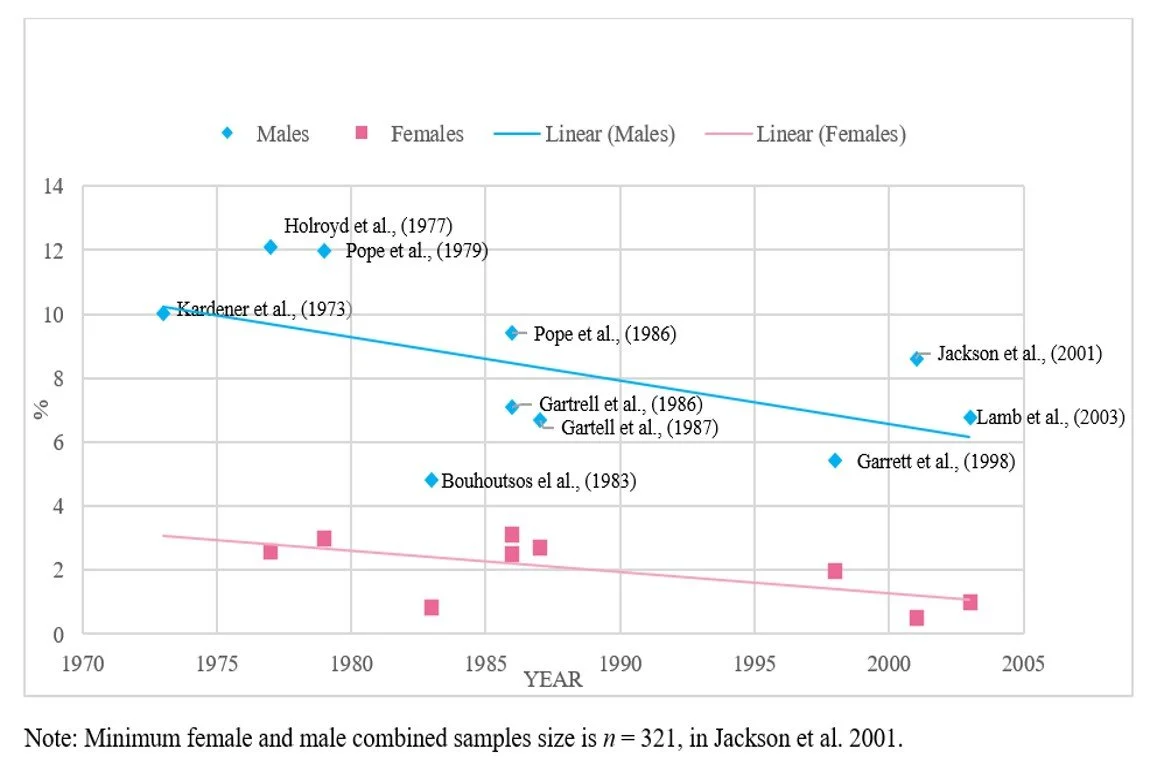
About 7% of males and 1.5% of females is the current estimates.
This is old data and while the trend itself appeared to have been declining, so too was it becoming less fashionable to admit to such violations, even anonymously and for the same reason we might assume that self-report figures have always been underestimates. Current rates are hard to gauge and hard to gain ethics approval to research. But this is an iceberg problem anyway, whatever amount of sexual boundary violations do occur, we can assume there a several fold greater number of other types of misconduct.
Here's a few stark truths about our profession:
The closed door necessary to protect the client’s confidentiality also makes them more vulnerable to exploitation.
Psychology and the philosophical “hard problems” that underpin it make a wide range of therapist behaviours plausibly justified.
Client’s will often feel that their status as a person seeking mental help, undermines their credibility as a complainant to begin with, especially in a “my word against yours” standoff caused by point 1 and the credible obfuscating a therapist has available due to point 2.
The fundamental ingredients of therapy make it vulnerable to exploitation, especially in the private practice setting where, as it happens, salaries can easily be double those made in government roles which typically involve more supervised practice.
I am not suggesting that our profession is infested by psychopaths. This would almost certainly be wrong and is also a dangerous red-herring. Most instances of misconduct, are more likely to be committed in the context of therapist stress, burnout, overwork and low supervision rather than premeditated predation. That is to say, most violating psychologists have more in common with you and me than what they do Hannibal Lecter and a blind-spot can ensue if we attribute violations to “bad apples”. Violating therapists often explain their infractions as misguided efforts to help their clients, buckling under the impossible weight of needing to save everyone (See Gabbard’s Masochistic Surrender).
Plainly, not everyone should be doing this job and some won’t be in a position to determine that themselves. The 18-year-olds who commence a single, five-year degree and from the beginning lock-in careers as practicing psychologists, will report adverse childhood experiences (ACE scores) at a rate about twice that of the average person (Dickeson, 2017). While this isn’t necessarily a bad reason for gravitating towards the profession and may even come with some advantages (see Barnett, 2007 – and the rest of the Wounded Healer literature), it indicates a potential volatility. Ivey and Partington (2012) found that clinical psychology programme selectors actively distinguished between applicants whose lived experience appeared resolved, treating it as a potential asset, and those whose woundedness appeared unresolved, the latter associated with risk of boundary compromise and impaired self-reflection. This type of evaluation and any evaluation like it, disappears with a single 5-year pathway. The Board Chair has assured the profession that this reform is "not about changing the threshold for general registration, but rather, simplifying the way we train psychologists to meet that high threshold". My concern is that the threshold is not the only thing that matters.
Your consultation to the proposal can be made here: https://www.psychologyboard.gov.au/News/Current-Consultations.aspx
NB: In this blog I have discussed boundary violations and childhood adversity in close proximity. I do not mean to imply a direct association between the two, or to suggest that therapists who experienced significant adversity are more likely to engage in misconduct.
Ned Dickeson is a clinical psychologist based in Adelaide, Australia.
This is a short essay and not intended as a systematic literature review.
I have used AI for artwork, research and proofreading but not for ideas or prose .
Refrences
Barnett, M. (2007). What brings you here? An exploration of the unconscious motivations of those who choose to train and work as psychotherapists and counsellors. Psychodynamic practice, 13(3), 257-274.
Dickeson, E. (2017). The prevalence and implications of wounded healers: A systematic review of the literature. Unpublished literature review. University of South Australia.
Garrett, T., & Davis, J. D. (1998). The prevalence of sexual contact between British clinical psychologists and their patients. Clinical Psychology & Psychotherapy: An International Journal of Theory and Practice, 5(4), 253-263.
Holroyd, J. C., & Brodsky, A. M. (1977). Psychologists' attitudes and practices regarding erotic and nonerotic physical contact with patients. American psychologist, 32(10), 843.
Ivey, G., & Partington, T. (2014). Psychological woundedness and its evaluation in applications for clinical psychology training. Clinical psychology & psychotherapy, 21(2), 166-177.
Kardener, S. H., Fuller, M., & Mensh, I. N. (1973). A survey of physicians' attitudes and practices regarding erotic and nonerotic contact with patients. American Journal of Psychiatry, 130(10), 1077-1081.
Lamb, D. H., Catanzaro, S. J., & Moorman, A. S. (2003). Psychologists reflect on their sexual relationships with clients, supervisees, and students: Occurrence, impact, rationales and collegial intervention. Professional Psychology: Research and Practice, 34(1), 102.
Pope, K. S., Tabachnick, B. G., & Keith-Spiegel, P. (1987). Ethics of practice: The beliefs and behaviors of psychologists as therapists. American Psychologist, 42(11), 993.
Stake, J. E., & Oliver, J. (1991). Sexual contact and touching between therapist and client: A survey of psychologists' attitudes and behavior. Professional Psychology: Research and Practice, 22(4), 297.
